- Core Thesis: Across information, judgment, and allocation, an intelligent layer lets investors accumulate memory, reason alongside agents, and pace capital with the full book in view.
- Why It Matters: Signal volume keeps growing while attention stays flat, so manual triage, one-off analysis, and deal-by-deal commitments are the first to lose.
- Strategic Direction: Build continuous memory, adaptive judgment, and a living allocation view, while access, execution, and liquidity remain human and specialist work.
 Click to enlarge
Opening
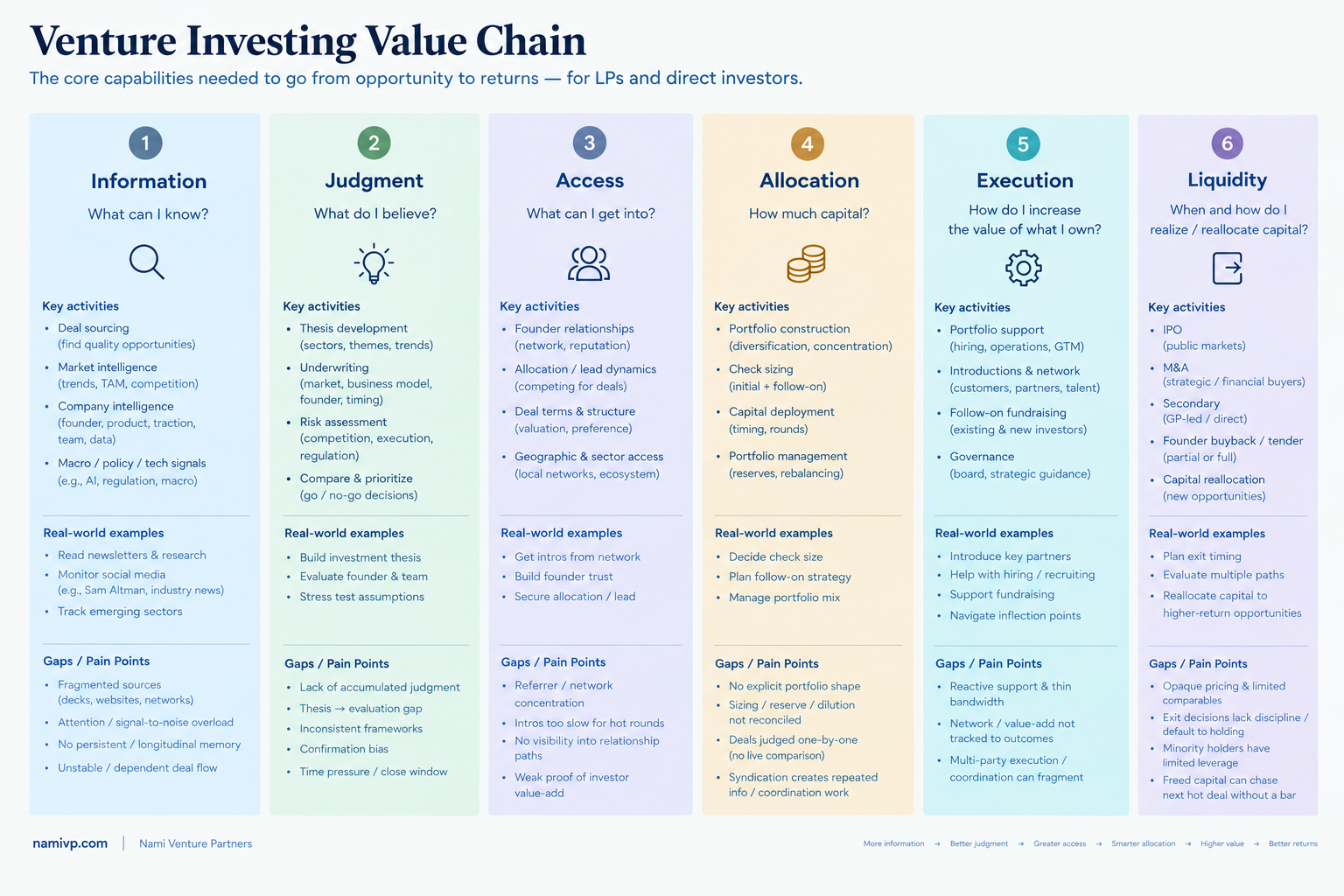
For investors stepping into direct venture investing, the unease rarely starts with a lack of opportunities. It starts with three quieter doubts: how do I know what deserves attention, how do I know what to believe, and how do I know how much to commit.
In our own workflow we break venture investing into six stages. This article focuses on three of them: information, judgment, and allocation. Not because the other three matter less, but because these three are where an intelligent layer changes the shape of the work itself, from manual triage and scattered notes into continuous memory, structured comparison, and disciplined pacing.
Information: What Can I Know
The daily reality is familiar to anyone who has tried to invest directly. Decks arrive by email, intros come through coffee chats, newsletters pile up, and X and LinkedIn never stop. A GitHub repo starts moving, a hiring spike appears, a niche community starts talking, but none of it arrives in one place. The problem is not a lack of information. It is that the volume outpaces what anyone can process without letting the important signals slip past.
What gets lost first is memory across time. A founder publishes an article a year ago that has not gone viral yet. Nothing about it demands a decision on the day. Six months later more evidence accumulates around the same person and the same startup, and a thesis starts forming. Without a system that stores that early trace and keeps tracking the signal, each encounter restarts from zero. The investor remembers the feeling but cannot reconstruct when the conviction began or what confirmed it.
What an intelligent layer changes
What is missing is not another database. It is a layer that continuously accumulates what was seen, structures it into usable records, and reuses it the next time the same name appears.
- Remember everything: deck, website, LinkedIn, X, GitHub, hiring signals, and fundraising history sit in one persistent record with versions across time, so each new trace adds weight instead of restarting the story.
- Surface early: the same sources a human would watch are monitored persistently, so a founder article, repo movement, or community chatter registers months before it becomes an obvious deal.
- Route exceptions: only the outliers reach the human with the full history attached, so attention goes to high-value diagnostics rather than first-pass filtering.
Judgment: What Do I Believe
The judgment problem starts earlier than the deal. Most investors carry a thesis made of blurred layers: philosophy, sector, and belief mixed together at keyword level. Almost everything enters deep evaluation because the thesis cannot reject fast. Each opportunity then gets a bespoke deep dive. Market math is rebuilt bottom-up, unit economics get stressed, a demo impresses while the technical review gets skipped, because the window closes in days and the numbers come from the founder unverified.
What breaks down next is comparison. Every deal is judged on different dimensions, with no common scorecard held still. The latest hot opportunity rewrites the standard on the spot, and earlier rankings were never saved, so nobody notices the drift. Risks are named in generic terms, market risk and team risk copied into each memo, while the one specific reason this deal could fail never gets named. Deciding alone, liking the founder quietly becomes the whole case, and because nothing is written down, the next deal starts from zero.
What an intelligent layer changes
What is missing is not more analysis. It is a partner that remembers how you judged before and reasons through the next one with you, instead of resetting each time.
- Learn your bar: agents absorb past passes, wins, and misses and sharpen what earns a yes over time, so the standard adapts with evidence rather than drifting silently with the latest hot deal.
- Reason alongside you: agents rebuild the market math, stress the assumptions behind founder numbers, and surface the one specific reason this deal could fail, working through the evidence with you before excitement sets the terms.
- Hold the counter-view: the dissenting case is written and preserved next to the upside, so conviction has to survive its strongest objection instead of coasting on liking the founder.
Allocation: How Much Capital
Checks usually go out deal by deal. The shape of the book lives in someone's head: roughly how many bets, roughly what size, roughly over how many years. The check gets signed before anyone divides by valuation to see real implied ownership. Defending through the next rounds costs multiples of the first check, but that reserve is priced only when the next round arrives, and every follow-on relitigates whether to defend or release.
Without a live view, every deadline is a surprise. Each deal looks good on its own, so nothing gets compared and the budget is spent before the best opportunities appear. After the money goes out, each company reports different numbers at different times, ownership percentages go stale as dilution shrinks them, and winners and losers are treated the same until a round forces the call.
What an intelligent layer changes
What is missing is not more discipline. It is a living view of the book that keeps the plan, the pipeline, and the positions in one place, so each commitment is priced against the whole.
- See the book: bet count, check size, and pacing live against the plan with actuals tracked, so the math of the portfolio is always reconciled before the next check.
- Price the future: implied ownership, dilution, and reserve needs are computed before signing, with defend-or-release rules written while calm instead of relitigated under pressure.
- Pace the capital: a live pipeline with timing keeps deployment spread across time, so early excitement cannot spend the year in quarter one and follow-ons go to the positions the plan defends.
Takeaways
The split is deliberate. Agents take what compounds with data: sensing, memory, comparison, and pacing. Humans keep what compounds with trust: founder relationships, negotiation, governance, and the final call under uncertainty. Access, execution, and liquidity stay in human and specialist hands for that reason.
- The binding constraint in direct venture investing is the manual chain across information, judgment, and allocation, where volume outpaces what anyone can process, compare, and pace without support.
- An intelligent layer moves the human from first-pass triage to high-value diagnostics, from one-off analysis to adaptive judgment alongside agents, and from isolated checks to a living view of the book.
- The durable advantage is institutional memory: every signal, pass reason, and allocation decision compounds into a system the next decision can reuse.
Sources & Citations
- BNY Mellon Wealth Management: 2025 Investment Insights — Single Family Offices Report - Single family office investment trends and sector prioritization data.